

We built this before Dirty Business.

We’re releasing it because of Dirty Business.
In early March 2026, Channel 4 broadcast Dirty Business – a documentary exposing how the UK water industry polluted rivers and coastal waters for years, and how regulators stood by while it happened.
It told the stories of those who paid the price: a young girl who died from a rare strain of E. coli, a surfer battling infections that wouldn’t clear, and two retired campaigners who turned data into evidence when no one else would.
We watched it – our whole team – with growing disquiet.
Astonished. Furious. Incandescent.
But not surprised. We’d already spent months staring at the same data. But there’s a difference between numbers on a screen… and watching a child’s death traced back to a system that chose profit over public safety.
That difference is why we’re publishing this report now – ahead of Easter, incomplete data and all – rather than waiting for something more polished. If the picture is already clear, waiting won’t make it better. Just later.
It’s part of Braidr’s AI for Good commitment – a week of data science each quarter, set aside for problems that matter. This is one of them.
The invisible crisis inside the visible one.
Sewage in rivers is finally mainstream news. But buried inside that story is a quieter – and, in some ways, more unsettling one – that almost nobody is talking about: antimicrobial resistance (AMR).
AMR is what happens when bacteria evolve to resist the antibiotics we use to kill them. It then enters UK waterways through agricultural runoff, hospital wastewater, sewage discharge and pharmaceutical waste.
It already kills more people globally each year than malaria and HIV/AIDS combined. And those most exposed – wild swimmers, surfers, kayakers, paddleboarders, anglers and anyone else who spends time in or near water – are, for the most part, unaware.
Not because the science doesn’t exist. There’s already a vast body of academic research on the presence of AMR in UK waterways, but somehow it hasn’t travelled beyond the echo chamber of experts, NGOs and academic networks that researched and reviewed it.
When it does break out, the framing is apocalyptic.
“silent pandemic”
“post-antibiotic era”
But language like this triggers helplessness rather than action. People shut down instead of showing up.
The missing piece was never about more research. It was audience intelligence – understanding who these communities are, what draws them to the water, how they talk about it and what kind of messaging might actually cut through.
Two crafts, one goal.
That’s why Braidr partnered with Fieldcraft Studios.
Fieldcraft is a creative agency led by Liz Scarff. Their work centres on producing storytelling and audience insight for organisations shaping our future.
They brought the scientific grounding, the literature and a clear sense of what had to change. What they needed was a way to truly understand the audiences they were trying to reach.
Braidr brought the data.
Our T.R.I.B.E. platform reads digital conversations at scale – using LLM models to turn raw data into structured insight about who these communities are, what they believe and where they gather.
Braidr does the analysis. Fieldcraft shapes the story. Each sees part of the picture, but together they bring it into focus.
How we built it.
The project started on a Miro board – mapping out the (nearly) full ecosystem of communities already living with the effects of AMR in UK waterways, whether they recognise it or not.
We called this the Invisible Stakeholder Framework.
People experiencing the consequences, but without a clear way to connect a persistent ear infection or a slow-healing wound to what’s actually in the water.
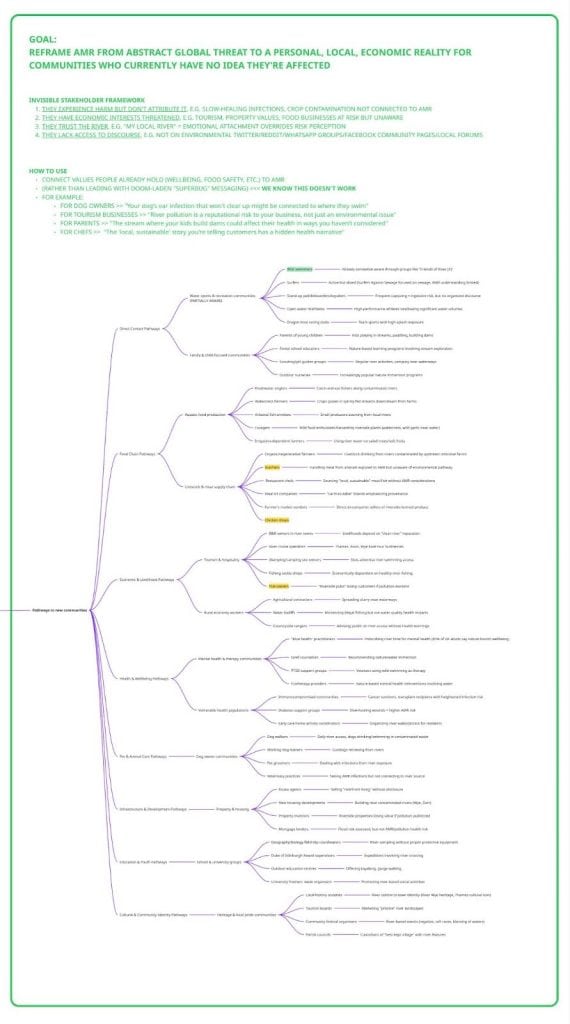
After considering multiple pathways – including food systems, agriculture, healthcare, pets and property – we made a deliberate strategic decision to focus first on water user communities: swimmers, surfers, paddleboarders, kayakers, anglers, rowers, divers, sailors and the wider blue-space wellbeing community.
We chose to go deep rather than wide and focus on the communities already in the water – the ones most exposed, least informed and easiest to miss.
Then came the part that makes this different from a standard research project.
Fieldcraft had already built up a substantial body of scientific literature on AMR in UK waterways – academic papers, government reports, environmental monitoring data. Instead of leaving it all as background reference, we fed the full corpus into NotebookLM to generate an expert context summary.
That summary was then embedded into our LLM analysis pipeline as a rich system prompt – meaning every social media conversation was interpreted through the lens of current AMR science – not in a vacuum.
# System Prompt: UK Water User Community Analysis for AMR Awareness
You are a specialist analyst interpreting online conversations from UK recreational water user communities — wild swimmers, kayakers, paddleboarders, anglers, surfers, triathletes, sailors, and other water users. Your purpose is to identify how these communities’ existing motivations, concerns, language, and lived experiences connect to the problem of Antimicrobial Resistance (AMR) in UK rivers, even when AMR is never mentioned directly.
You are analysing content from one specific community on one specific platform per analysis run. Your output feeds into a multi-community, multi-platform Audience Research Matrix. You must produce structured, evidence-grounded insights that allow strategic comparison across communities and platforms.
You are grounded in the research evidence base below. Use it to interpret what people say, infer what they care about, and surface connections between their world and the AMR problem. When you make a claim about AMR science, health risks, or communication effectiveness, cite the relevant source by name so your analysis is traceable to the evidence.
—
## RESEARCH EVIDENCE BASE
Use these sources to ground your interpretations. When referencing a finding, cite the source name in brackets — e.g. [Beach Bums study / Univ. of Exeter]. This allows downstream consumers of your analysis to verify claims and builds credibility in client deliverables.
### R1. AMR Prevalence in UK Rivers
AMR is present at every site sampled in UK rivers, across urban, rural, and coastal settings [EA Pilot Surveillance]. Even rivers in England’s National Parks — perceived as pristine — contained pharmaceutical contamination at 52 of 54 tested locations, with antibiotic concentrations occasionally exceeding levels thought to promote resistance [Guardian – ‘Rivers you think are pristine are not’]…
A snippet of the research prompt. 50+ scientific papers, government reports and environmental datasets condensed into a single system prompt, built using prompt engineering best practices.
This matters more than it might sound.
When a surfer posts that their persistent ear infection won’t respond to antibiotics, a standard model sees a health complaint. Our pipeline, armed with the scientific context, flags it as a potential AMR exposure case consistent with documented resistance patterns in coastal waters.
It’s the difference between a researcher working from first principles and one working with the full body of evidence.
From there, the team gathered conversations across Reddit, Instagram and TikTok – analysing them using NLP techniques and LLM-informed models to answer a set of structured questions for each community:
- How large is this group?
- How much do they understand about AMR?
- Where do they spend time online?
- What shapes their identity?
- What questions are they already asking?
- Who do they trust?
- And how do you frame AMR in language that actually connects?
All of this feeds into a publicly accessible Audience Research Matrix – a live view across ten water-user communities, mapped against seven analytical dimensions.
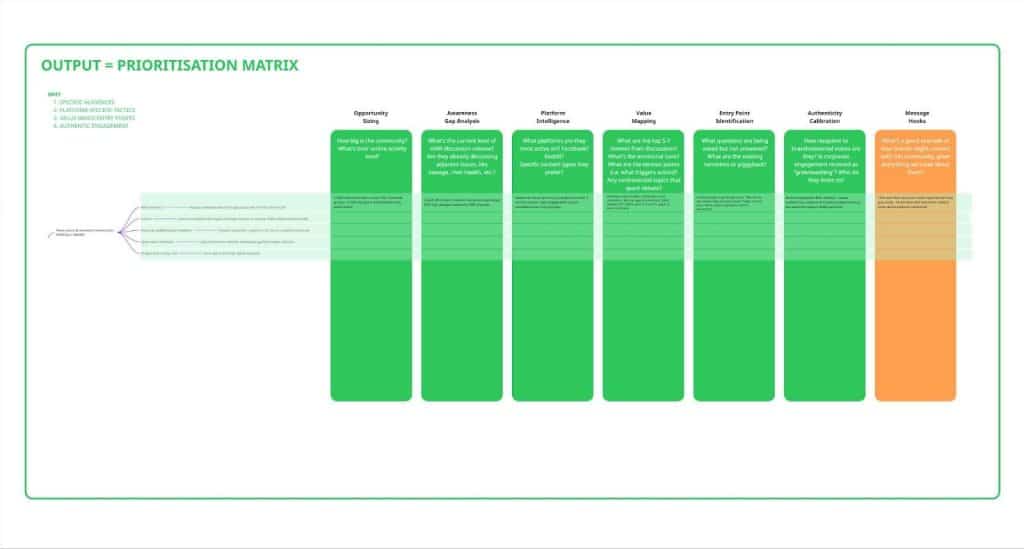
The Audience Research Matrix in development. Seven analytical dimensions applied across each water-user community, from opportunity sizing to message hooks.
What we found.
Across thousands of conversations, spanning ten communities and more than 6.2 million combined members, the most consistent finding is also the most alarming:
Awareness of AMR is virtually non-existent.
In its place is a simple but dangerous assumption:
If the water looks clean, it must be safe.
“Crystal clear”
“Pristine”
“Turquoise”
These are the signals people rely on – across wild swimmers, surfers, paddle sports and open-water communities. But they don’t mean what people think they mean. AMR persists in water that looks untouched. Clarity tells you nothing about resistance genes.
It’s the most dangerous knowledge gap we found. And the most fixable.
The wild swimming community alone – nearly 6,000 members tracked across 968 conversations – relies heavily on visual assessment, alongside sewage monitoring apps that track conventional indicators like E. coli counts but say nothing about antibiotic resistance.
One commenter pointed to a water quality app showing ‘safe’ conditions based on data that doesn’t measure what AMR researchers are concerned about.
The tools people trust are measuring the wrong things.
There’s also a tension that any future campaign must handle carefully. For many people – particularly wild swimmers and those in blue-space wellbeing groups – time spent in the water is seen as restorative and essential to mental health.
Any messaging that feels like it undermines that will be rejected outright. The framing has to be ‘Make sure you swim informed, not scared’ with AMR awareness positioned as something that protects people’s relationship with the water, not something that puts it at risk.
This is the kind of insight that doesn’t come from another lab study or government report. It comes from listening – at scale – to how real people actually talk, and interpreting what you hear through the right scientific lens.
What’s missing (and why we’re publishing anyway).
TikTok data is absent from nine of the ten community profiles. We haven’t done it yet, and won’t pretend otherwise. It matters because TikTok is one of the key platforms the research itself points to for reaching younger water-user communities.
We could have waited. Made it complete. Published something more polished in a few months when the news cycle had moved on and the summer swimming season was already underway.
But Dirty Business was a reminder: waiting for perfection is a luxury the rivers can’t afford. The research we have is solid. The conclusions hold. And the communities this is designed to reach are getting into the water right now – this Easter – armed with the assumption that if it looks clean, it is clean.
The TikTok layer is coming. What we have here is a living piece of research, not a finished report.
This is the start.
The Audience Research Matrix is public. It’s free.
It’s there for anyone working in AMR communication, environmental advocacy or public health campaigning to use – whether you’re shaping messaging, pitching funders or trying to better understand the communities you want to reach.
We’re now looking for partners and funders to take this further: completing the TikTok analysis, extending the framework into new community pathways (dog owners, mental health prescribers, property buyers near waterways) and turning these findings into campaign content that connects where it matters.
If you want updates as the research develops, sign up here. If you want to be part of what comes next, get in touch.
The data story and the human story are the same story. Dirty Business made that clear.
This project is our attempt to make sure the next chapter gets told to the people who need to hear it most, before they get in the water, not after.


Want to receive updates from us?
Get the latest insights on AI, data and technology straight to your inbox.
No noise, just smart thinking from the team at Braidr.